Last Updated on June 22, 2026
Choosing the right Content Management System (CMS) is one of the most important decisions when building a website. Performance, security, scalability, ease of use, and SEO capabilities all play a major role in determining which CMS is best for your project.
If you are wondering “Which CMS is fastest: Drupal, WordPress, or Joomla?”, you’re not alone. These three popular open-source CMS platforms power millions of websites worldwide and each has its own strengths and weaknesses.
Among the most popular CMS platforms today are WordPress, Joomla, and Drupal. While all three are free and open-source, they differ significantly in performance, usability, and flexibility. You can learn more about these platforms on the official websites of WordPress, Joomla, and Drupal.
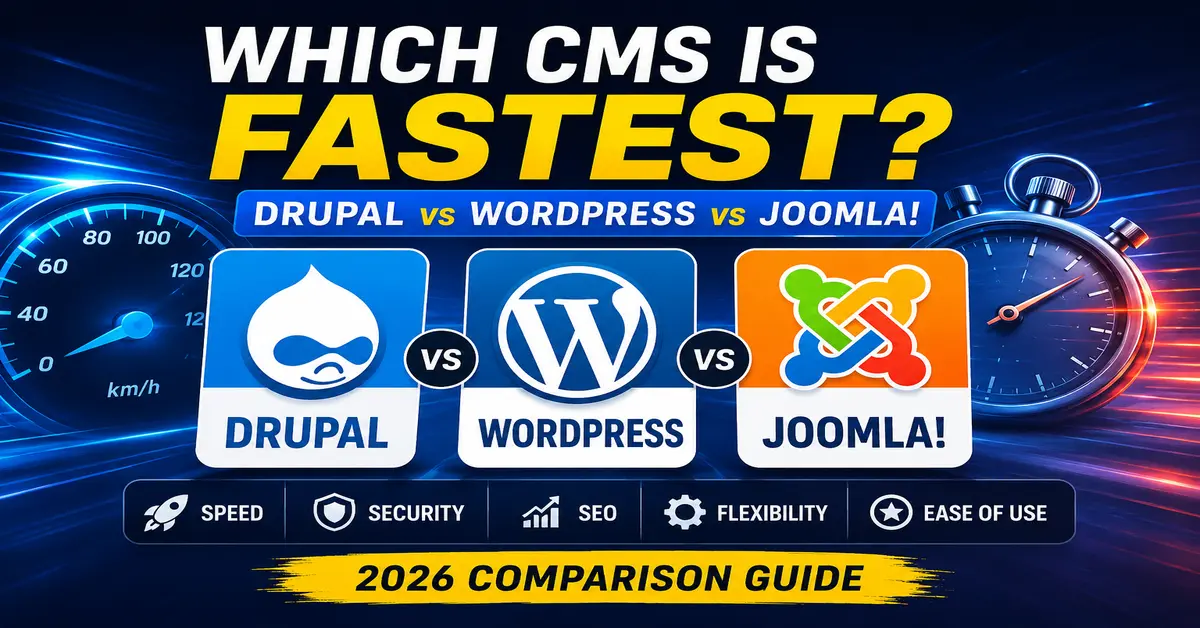
In this updated 2026 comparison, we’ll compare Drupal, WordPress, and Joomla in terms of speed, performance, security, SEO, flexibility, ease of use, and overall value to help you make the right choice.
What Is a Content Management System (CMS)?
A Content Management System (CMS) is software that allows users to create, manage, edit, and publish website content without needing extensive programming knowledge.
Modern CMS platforms provide:
- User-friendly content editing tools
- Media management capabilities
- Theme and template support
- Extension and plugin ecosystems
- User management and permissions
- SEO and marketing tools
- Security and performance optimization features
CMS Comparison: Drupal vs WordPress vs Joomla
WordPress Overview
WordPress is the world’s most popular CMS and powers a significant percentage of websites across the internet. Originally created as a blogging platform, it has evolved into a powerful website development framework capable of building blogs, business websites, eCommerce stores, membership platforms, and more. If you are new to WordPress, you may also want to read our guide on What is WordPress and How Does it Work? to understand why it remains the world’s most popular CMS.
WordPress powers millions of websites worldwide and continues to be one of the most popular content management systems available today. Visit the official WordPress website for downloads, documentation, and community resources.
Advantages of WordPress
- Easy to install and manage.
- User-friendly dashboard suitable for beginners.
- Thousands of free and premium themes.
- Large plugin ecosystem for additional functionality.
- Strong community support and documentation.
- Excellent compatibility with SEO tools.
- Wide range of hosting options.
Many users compare WordPress with Joomla before choosing a CMS. Read our detailed comparison: Why Joomla is Better than WordPress?
WordPress Performance and Speed
WordPress can be extremely fast when combined with quality hosting, caching, image optimization, and CDN services. Modern optimization plugins make it easy to achieve excellent Core Web Vitals scores.
Joomla Overview
Joomla is a powerful open-source CMS that sits between WordPress and Drupal in terms of complexity. It offers more built-in functionality than WordPress while remaining easier to manage than Drupal.
Joomla offers powerful template override functionality that allows developers to customize output without modifying core files. Learn more in our tutorial: How to Create a Joomla Layout Override.
Advantages of Joomla
- Built-in multilingual support.
- Advanced user access control.
- Flexible content management system.
- Strong security features.
- Suitable for business and government websites.
- Excellent extension ecosystem.
Joomla Performance and Speed
Joomla delivers impressive performance because many features are included in the core CMS. With proper caching and modern hosting, Joomla websites can achieve excellent loading speeds.
Joomla offers advanced user management and multilingual capabilities directly in the core CMS. Additional documentation and resources are available on the official Joomla website.
Drupal Overview
Drupal is a highly flexible CMS designed for enterprise-level websites, government portals, and large-scale applications. It provides powerful content management capabilities and advanced security features. If you are new to Joomla, read our beginner-friendly guide: What is Joomla and Joomla Architecture?
Advantages of Drupal
- Excellent scalability.
- Enterprise-grade security.
- Advanced content modeling.
- Powerful user management.
- Strong API integration capabilities.
- Ideal for large and complex websites.
Drupal Performance and Speed
Drupal performs exceptionally well on high-traffic websites and large content-heavy projects. Its advanced caching system and scalable architecture make it suitable for enterprise environments.
Drupal is widely used for enterprise and government websites because of its scalability and security. Learn more from the official Drupal website.
Drupal vs WordPress vs Joomla: Speed Comparison
| Feature | WordPress | Joomla | Drupal |
|---|---|---|---|
| Ease of Use | Excellent | Very Good | Moderate |
| Out-of-the-Box Speed | Good | Very Good | Very Good |
| Scalability | Good | Very Good | Excellent |
| Enterprise Performance | Good | Good | Excellent |
| SEO Flexibility | Excellent | Very Good | Excellent |
Which CMS Is Fastest?
When comparing Drupal, WordPress, and Joomla in 2026, there is no single winner for every project.
- WordPress is the best choice for beginners, bloggers, freelancers, and small businesses.
- Joomla is ideal for business websites, membership portals, and multilingual websites.
- Drupal is the preferred option for enterprise projects, government websites, and highly customized applications.
For pure out-of-the-box performance, Joomla often performs very well. For enterprise scalability, Drupal has an advantage. For flexibility and ease of optimization, WordPress remains the most popular choice.
When evaluating website speed, it is important to consider metrics such as Largest Contentful Paint (LCP), Interaction to Next Paint (INP), and Cumulative Layout Shift (CLS), which are part of Google Core Web Vitals.
You can test the performance of WordPress, Joomla, or Drupal websites using Google PageSpeed Insights.
Final Verdict
If your goal is to launch a website quickly and manage it easily, WordPress is usually the best option. If you need advanced user management and multilingual support, Joomla is an excellent choice. If you require enterprise-level scalability, security, and customization, Drupal is the strongest contender.
Ultimately, the fastest CMS depends on hosting quality, caching, CDN configuration, image optimization, and website architecture. Any of these platforms can deliver outstanding performance when properly optimized.
Still deciding which CMS is right for your project? Browse our complete collection of Joomla Tutorials and WordPress Tutorials
for practical guides and expert tips.
Regardless of which CMS you choose, regularly testing your site’s performance with Google PageSpeed Insights and following Core Web Vitals guidelines can significantly improve user experience and search engine rankings.
Stay updated with our latest news, special offers, and exclusive updates directly in your inbox.